
Statistics
We looked inside some of the posts by theoutcasted92 and here's what we found interesting.
Average Info
Notes Per Post
549K
Likes Per Post
271K
Reblog Per Post
277K
Reply Per Post
553
Time Between Posts
16 days
Number of Posts By Type
Text
11
Photo
6
Last Seen Tumblr Blogs



Fun Fact
Premium Tumblr themes are available from anywhere between $9 to $49.
Text
Best apps to kill time on 😻
Been seeing some posts circulating about popular websites/apps and wanted to make my own version. These are apps I’m way too addicted to. Am I missing any?
Edit: Sorry for all the time I’ve taken away from your life.
Love Nikki- my favorite dress-up game
CharacterHub- make beautiful wikis for your characters and art
Date My Music by the Shelf app- find out how dateable you are based on your Spotify
Hangout.fm- music with your friends, ultimate music discovery engine
Ellipsus- because f*ck google docs
Hinge Cheater - check if your boyfriend is still on Hinge
Shroomy - Therapy but from a talking mushroom
Party In My Dorm - college simulation game!
Terrarium - build the ultimate garden empire
Rise - really helpful self-care sleep routine
Breathwrk - this app will help you get rid of social anxiety
Phone Case DIY - design your phone case
Idle Human - build a human from scratch. for reals.
Pocket Styler - build a dream closet you want
Stadium Live - sports, games, and friends - all in one
Dragon Mania Legends - breed the cutest dragons
Sweatcoin - you can literally walk and get paid
BitLife - a life simulator
Fabulous - best daily routine planner
Bee Factory - build and raise your bee empire!!!! You’re welcome 😉
7K notes
·
View notes
Photo

💎 𝗡𝗲𝘄 𝗶𝘁𝗲𝗺! Fountain Harp
Wondrous item, very rare (requires attunement) ___ You must be proficient with harps to attune to this instrument. This traveller’s harp doesn’t have strings: instead, thin streams of water pour from the top. The streams vanish into nothingness before reaching the bottom of the harp. When played, the harp emits a tone like a raindrop hitting metal. Even if the harp is held on its side, the streams of water fall toward the bottom of the harp. The harp weighs 3 pounds and requires two hands to play. 𝙎𝙤𝙣𝙜𝙨 𝙤𝙛 𝙒𝙖𝙩𝙚𝙧. While holding the harp, you can spend 1 minute playing a special song from it. At the end of the minute, you cast one of the following spells from it (save DC 16): “control water”, “create or destroy water” (3rd-level version), or “water walk”. If a spell requires you to concentrate on it, you must use an action on each of your turns for the duration to continue playing the harp. 𝙎𝙪𝙢𝙢𝙤𝙣 𝙒𝙖𝙩𝙚𝙧 𝙀𝙡𝙚𝙢𝙚𝙣𝙩𝙖𝙡. While holding the harp, you can use an action to play it and cast the “conjure elemental” spell from it. This version of the spell can only call forth a water elemental, and it doesn’t require your concentration. However, you must use your action to continue playing the harp on each of your turns for the duration of the spell. The spell ends early if you cease to play the harp, at which point the elemental immediately disappears. Once this property of the harp has been used, it can’t be used again until the next dawn. 𝙒𝙖𝙩𝙚𝙧𝙮 𝘿𝙞𝙨𝙘𝙤𝙧𝙙. If you’re not in water, you can use action to pluck a string from the harp to cast the “acid arrow” spell from it, using a spell attack bonus of +8; the spell deals no damage if you miss with the attack. If you’re underwater, you can use an action to cast the “thunderwave” spell from it (2nd-level version, save DC 16); a creature that succeeds on the saving throw takes no damage from the spell. ___ ✨ Patrons get huge perks! Access this and hundreds of other item cards, art files, and compendium entries when you support The Griffon’s Saddlebag on Patreon for as little as $3 a month!
162 notes
·
View notes
Text


Ruined City
Crumbled homes and shattered walls loom over the stone streets of this ruined city, where ivy coils through broken windows and silence reigns. Once a thriving town, now only ghosts and scavengers walk its forgotten streets.
Come get lost in this Ruined City! This map pack features:
10 total maps, including Overgrown Streets, Haunted Districts, and much more!
Patrons get access to gridded/ungridded and watermark-free maps. The grid size of each map is 26x39.
Download the original map for free here.
92 notes
·
View notes
Text


Cahoot – Tiny fiend, neutral evil
A subtle silhouette hopping from tree to tree, shimmering eyes watching from above, inaudible whispering filling the minds of the wandering adventurers. The cahoot is a quite sinister creature inhabiting regions wherever dark forests cast their shadows over secluded villages. Only a few know too well to avoid the overgrown paths. Most travelers, however, gravely underestimate the dangers. After all, a cahoot never schemes alone...
Kindly consider to support me on Patreon to gain access to monster pages, tokens & artwork of over 300 quirky creatures as well as dozens of potion & item cards based on their lore.
178 notes
·
View notes
Photo

Ally: Lady Keiva Marzanna, The Waylaid Huntress
“ What are you standing around for? Any longer and It’ll kill all of them, think you can distract it long enough for me to get off another few shots?”
Adventure Hook: Shots and screams ring out as the players approach the city, along with the roaring of some great beast and the thunder of its footsteps across snowy earth.
Arriving, they find a grisly scene in action: a procession of riders and their mounts slaughtered, and a towering jotun murderously trundling towards a crowd of fleeing travelers.
A woman in a voluminous winter riding gown sits with her back to a tree, face stained with blood, black powder, and frozen tears. She labors to reload her massive flintlock rifle braced against a broken leg and splintered ribs. With a plea, she turns and fires, drawing the jotun’s attention to her position and the party’s presence.
Setup: It was an inauspicious morning when Lady Keiva set out with her brother Valiboor’s hunting party, restless of her life as the family’s courtly heir and jealous of her younger sibling’s marital pursuits. As it happened, this was the morning a giant burst from the thick ice of the nearby trade river and decided to besiege the city. Barely past the gate , Valiboor and his hunting party turned about to try and delay the beast till proper help could arrive and managed to harry it for some time as it picked them off in twos and threes. Though Keiva had held back as was her duty as noble heir, she took up her brother’s gun after watching Valdiboor and his last few riders fall beneath a tree hurled by the jotun.
The party finds her just having been swatted off her mount, injured and mad with avenging grief she pulled her body free of the mangled beast’s carcass and limped over to find a better shooting vantage. If they aid her, the party will earn the favor of one of the city’s most powerful noble families, that is if they survive a confrontation with an icy, bone-crunching colossus first.
Keep reading
854 notes
·
View notes
Photo

💎 𝗡𝗲𝘄 𝗶𝘁𝗲𝗺! Amberblood Heart
Wondrous item, very rare (requires attunement) ___ This stone sculpture of a heart flows with slow-moving liquid amber. At its center is a crystalline amber core. As part of attuning to the heart, you must hold it against your chest for the duration. Once you attune to it, it magically vanishes into your chest to reinforce your heart and body; faint amber cracks then line your skin. While attuned to the heart, you gain the following benefits: - You have resistance to acid and poison damage. - You can’t become diseased, petrified, or poisoned. - For every 10 years that pass, your body ages only 1 year. - Your weight doubles. If your attunement to the heart ends, it magically appears in your open hand or in the nearest unoccupied space. ___ ✨ Patrons get huge perks! Access this and hundreds of other item cards, art files, and compendium entries when you support The Griffon’s Saddlebag on Patreon for as little as $3 a month!
298 notes
·
View notes
Photo

⚔️ 𝗡𝗲𝘄 𝗶𝘁𝗲𝗺! Bolt of Wild Lightning
Weapon (bolt), rare ___ This crossbow bolt is made of zigzagging glass. When you use a crossbow to fire the bolt at a target that’s within 100 feet of you, the bolt transforms into a crackling bolt of lightning. The bolt recreates the effects of the lightning bolt spell (save DC 15), extending from you in the direction of the target of the attack. If the target is made of metal or wearing metal armor, it has disadvantage on the saving throw and the lightning immediately arcs toward up to four random targets that are within 30 feet of the original target and not within the line of lightning. Each random target then makes the saving throw against the bolt’s effects; it makes the save with advantage unless it’s also made of metal or wearing metal armor. Once the bolt transforms into the bolt of lightning, the ammunition is destroyed. ___ ✨ Patrons get huge perks! Access this and hundreds of other item cards, art files, and compendium entries when you support The Griffon’s Saddlebag on Patreon for as little as $3 a month!
160 notes
·
View notes
Text

✨New item!✨ Invoker’s Band Ring, uncommon (requires attunement)
The detailing on this ring slowly rearranges itself into myriad patterns.
While wearing this ring, you gain the benefit of one Eldritch Invocation from the warlock class. You can choose the invocation the first time you attune to the ring. Your spellcasting ability for the invocation is Intelligence, Wisdom, or Charisma (choose when you attune). If the invocation has a prerequisite of any kind, you can choose that invocation only if you're a warlock who meets the prerequisite. If the invocation grants a spell that requires a warlock spell slot to use, you can cast it once per long rest without expending a spell slot instead.
Curse. By attuning to this ring, you have agreed to a minor pact with an otherworldly being. You can only benefit from this ring if you satisfy the whims of your patron, in exchange for their gift. The patron linked to this ring is chosen by the GM or rolled randomly on the table below. You can end attunement to this ring with any spell that can remove curses, which also ends the pact. The gem on your ring reflects the mood of your patron, changing color in response to your actions. Occasionally, the patterning on the ring’s surface will arrange itself into writing that explicitly communicates your patron’s desires. Otherworldly Patrons:
Demented Devil: Your devilish patron torments you. Once per day, you have disadvantage on a single ability check, attack, or saving throw (chosen by the GM).
Fickle Fey: Your fey patron delights in your fumbles. Whenever you roll a 1 on an attack or Dexterity saving throw, you fall prone.
Charitable Celestial: Your celestial patron abhors wicked deeds. You have disadvantage on attacks against good-aligned creatures.
Leaching Lich: Your undead patron is leaching your life essence. Whenever you regain hit points from a spell, the amount you regain is halved.
Greedy Genie: The genie you serve demands a golden tithe. Each time you finish a long rest, 10 gp from your personal wealth vanishes.
Ominous Old One: You are plagued with horrible nightmares. Each time you attempt to take a long rest, you must first succeed on a DC 10 Wisdom saving throw or gain no benefit from the rest.
Invoker’s Bands allow the wearer to draw power from an otherworldly being that either crafted the ring or was bound to it somehow. Be careful, this power often comes with a hidden cost. - 🖌🎨 Like our work? Consider supporting us on Patreon and gain access to the hi-resolution art for over 200 magic items, printable item cards and card packs, beautiful creature art and stat blocks, and setting pdfs with narrative hooks and unique lore!🧙♂️ Thank you so much for your support! 💖
📜 Credit. Art and design by us: the Dungeon Strugglers. Please credit us if you repost elsewhere.
126 notes
·
View notes

Photo

⚔️ 𝗡𝗲𝘄 𝗶𝘁𝗲𝗺! War Mage’s Staff
Staff, very rare (requires attunement by a sorcerer, warlock, or wizard) ___ This staff can be wielded as a magic quarterstaff that grants a +2 bonus to attack and damage rolls made with it. At one end of the staff is a crystal orb, while a crystal blade is affixed to the other; your attacks with this weapon deal either bludgeoning, piercing, or slashing damage (your choice each time). The staff has 10 charges for the following properties. The staff regains 1d8 + 2 expended charges daily at dawn. If you expend the last charge, roll a d20. On a 1, the staff loses its Arcane Ward and Spells properties. On a 20, the staff regains 1d8 + 2 charges. 𝘼𝙧𝙘𝙖𝙣𝙚 𝙎𝙝𝙞𝙚𝙡𝙙. When you’re hit with an attack (but before taking any damage) and are holding the staff, you can expend 1 of the staff’s charges to roll a d4 and add the result to your AC against the triggering attack (no action required), potentially causing the attack to miss. You can continue to expend charges in this way to add additional d4s to the AC bonus, even after seeing the result of the previous d4 but before the damage is calculated. If you’re concentrating on a spell, the first d4 you roll per attack costs 0 charges. 𝙎𝙥𝙚𝙡𝙡𝙨. While holding the staff, you can use an action to expend 2 of its charges to cast one of the following spells from it, using your spell attack bonus and spell save DC: “chromatic orb” (4th-level version), “fire shield”, “freedom of movement”, “mirror image”, “misty step”, “ray of enfeeblement”, “thunderwave” (4th-level version), or “wind wall”. ___ ✨ Patrons get huge perks! Access this and hundreds of other item cards, art files, and compendium entries when you support The Griffon’s Saddlebag on Patreon for as little as $3 a month!
239 notes
·
View notes
Text
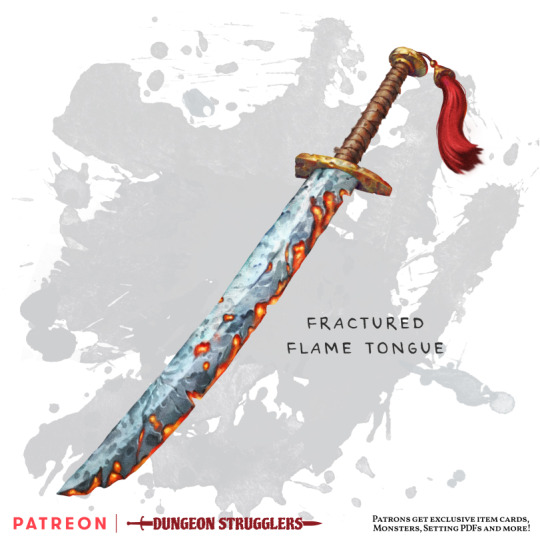
✨New item!✨ Fractured Flame Tongue Weapon (any sword), uncommon (requires attunement)
This ancient sword is deeply weathered and its flame tongue enchantment has corroded the blade from within.
You can use a bonus action to speak this magic sword's command word, causing meager flames to erupt from the blade. These flames shed bright light in a 10-foot radius and dim light for an additional 10 feet. While the sword is ablaze, it deals an extra 1d6 fire damage to any target it hits. The flames last until you use a bonus action to speak the command word again or until you drop or sheathe the sword. Roll a d20 each time you ignite the sword. On a 1, the fire sputters out and the sword permanently loses its magic. On a 20, the flames roar brilliantly for 1 minute, shedding bright light in a 100-foot radius and dim light for an additional 100 feet. The first time you hit a target with the sword within that period, the sword deals an extra 2d6 fire damage (for a total of 3d6) to the target and then the flames go out. - 🖌🎨 Like our work? Consider supporting us on Patreon and gain access to the hi-resolution art for over 200 magic items, printable item cards and card packs, beautiful creature art and stat blocks, and setting pdfs with narrative hooks and unique lore!🧙♂️ Thank you so much for your support! 💖
📜 Credit. Art and design by us: the Dungeon Strugglers. Please credit us if you repost elsewhere.
82 notes
·
View notes
Text

Whether transformed by the chaotic energies of wild magic, or created in the laboratory of a mad wizard, a mutant dragon is a frightening and unpredictable beast. Their bodies being in constant flux, only one thing about these dragons is constant: their insatiable appetite for destruction.
51 notes
·
View notes
Text
COLOURS in DESCRIPTION
colour is the lifeblood of a scene. here are ways not to over-use it.
Red: cardinal, coral, crimson, flaming, maroon, rose, wine, brick red, burgundy, carmine, cerise, cherry, chestnut, claret, copper, dahlia, fuschia, garnet, geranium, infrared, magenta, puce, ruby, russet, rust, salmon, sanguine, scarlet, tition, vermilion, roseate, rubicund, ruddy, rubescent, florid
Orange: apricot, tangerine, merigold, cider, ginger, bronze, cantaloupe orange, clay, honey, marmalade orange, amber
Yellow: blond, chrome, cream, gold, ivory, lemon, saffron, tawny, xanthous, sandy
Green: grassy, leafy, verdant, emerald, aquamarine, chartreuse, fir, forest green, jade, lime, malachite, mossy, pea green, pine, sage, sea green, verdigris, willow, spinach green, viridian
Blue: azure, beryl, cerulean, cobalt, indigo, navy, royal blue, sapphire, teal, turquoise, ultramarine
Purple: violet, indigo, lavender, lilac, mauve, periwinkle, plum, violet, amethyst, heliotrope, mulberry, orchid, pomegranate purple, wine, amaranthine, perse, violaceous, reddish-blue
10K notes
·
View notes
Text
Writing Reference: Topographical Elements

Ideas for Naming your Fictional Places
Buildings and stones brough, burton, caster, church, cross, kirk, mill, minster, stain, stone, wark ⚜ Examples: Crossthwaite, Felixkirk, Newminster, Staines, Whitchurch
Coastline features ey, holme, hulme, hythe, naze, ness, port, sea ⚜ Examples: Bardsey, Greenhithe, Sheerness, Southport, Southsea
Dwellings and farms barton, berwick, biggin, bold, by, cote, ham, hampstead, hamton, house, scale, sett, stall, thorpe, toft, ton, wick ⚜ Examples: Fishwick, Newham, Potterton, Westby, Woodthorpe
Fields and clearings combe, croft, den, ergh, field, ham, haugh, hay, ing, land, lease, lock, meadow, rick, ridding, rode, shot, side, thwaite, wardine, worth, worthy ⚜ Examples: Applethwaite, Cowden, Smallworthy, Southworth, Wethersfield
General locations and routes bridge, ford, gate, ing, mark, path, stead, stoke, stow, street, sty, way ⚜ Examples: Epping, Horsepath, Longford, Ridgeway, Stonebridge, Streetly
Hills and slopes bank, barrow, borough, breck, cam, cliff, crook, down, edge, head, hill, how, hurst, ley, ling, lith, mond, over, pen, ridge, side, tor ⚜ Examples: Barrow, Blackdown, Longridge, Redcliff, Thornborough, Windhill
Rivers and streams batch, beck, brook, burn, ey, fleet, font, ford, keld, lade, lake, latch, marsh, mere, mouth, ore, pool, rith, wade, water, well ⚜ Examples: Broadwater, Fishlake, Mersey, Rushbrooke, Saltburn
Woods and groves bear, carr, derry, fen, frith, greave, grove, heath, holt, lea, moor, oak, rise, scough, shaw, tree, well, with, wold, wood ⚜ Examples: Blackheath, Hazlewood, Oakley, Southwold, Staplegrove
Valleys and hollows bottom, clough, combe, dale, den, ditch, glen, grave, hole, hope, slade ⚜ Examples: Cowdale, Denton, Greenslade, Hoole, Longbottom, Thorncombe
NOTE
These elements are all found in many different spellings. Old English beorg ‘hill, mound’, for example, turns up as bar-, berg-, -ber, -berry, -borough, and -burgh. Only one form is given above (Thornborough).
Several items have the same form, but differ in meaning because they come from different words in Old English. For example, -ey has developed in different ways from the two words ea ‘river’ and eg ‘island’. It is not always easy deciding which is the relevant meaning in a given place name.
This resource does not distinguish between forms which appear in different parts of a place name. Old English leah ‘forest, glade’, for example, sometimes appears at the beginning of a name (Lee- or Leigh-), sometimes at the end (-leigh, -ley), and sometimes alone (Leigh) (K. Cameron, 1961).
Source ⚜ More: Word Lists ⚜ Notes & References ⚜ Worldbuilding
615 notes
·
View notes
Text
Fireball is actually an unfinished, unstable spell. It’s just, no wizard has ever been ballsy enough to try and cast the complete version before.
1K notes
·
View notes
Text


Here's my take on a mech pilot class! If you have any feedback, feel free to send it my way! I had a lot of fun working on this and I hope you enjoy it as well!
[DRIVE]
[HOMEBREWERY]
420 notes
·
View notes
Text
Writing Angry Scenes: Tips to Avoid Melodrama and Make It Real
Anger can be one of the most intense, relatable emotions to read—and one of the trickiest to write. When handled well, an angry scene can pull readers deep into the emotional world of a character, building tension and driving the story forward. But when handled poorly, anger can easily slip into melodrama, making the character’s feelings seem overblown, forced, or even cringe-worthy.
So how can you avoid these pitfalls and write anger that feels real and compelling? Here are some tips to make angry scenes powerful without overdoing it.
1. Understand What Fuels Your Character’s Anger
To write anger authentically, you need to understand its roots. People get angry for complex reasons—fear, frustration, betrayal, grief, and even love. Ask yourself what’s truly driving your character’s anger. Are they afraid of losing control? Do they feel abandoned or misunderstood? Are they hurt by someone they trusted? Anger rarely exists in isolation, so dig into the deeper emotions fueling it.
When you understand the core reasons behind a character’s anger, you can weave those nuances into the scene, making the anger more relatable and layered. Readers will feel the depth of the character's rage, not just the surface heat of it.
2. Show, Don’t Tell—But Don’t Overdo It
“Show, don’t tell” is classic writing advice, but it’s especially crucial in angry scenes. Don’t rely on generic phrases like “She was furious” or “He clenched his fists in anger.” Instead, look for unique ways to convey how this specific character experiences anger. Maybe their voice drops to a deadly calm, or their eyes narrow in a way that makes everyone around them uncomfortable.
That said, showing too much can backfire, especially with exaggerated descriptions. Over-the-top body language, excessive shouting, or too many “flaring nostrils” can tip the scene into melodrama. Use body language and physical cues sparingly and mix them with subtler reactions for a more realistic portrayal.
3. Use Dialogue to Reveal Hidden Layers
People rarely say exactly what they feel, especially when they’re angry. Angry dialogue isn’t just about yelling or throwing out insults; it’s an opportunity to show the character’s deeper thoughts and vulnerabilities.
Consider using controlled, icy responses or unexpected silences. Maybe your character says something hurtful in a low voice rather than screaming. They might express sarcasm, avoidance, or even laugh at the wrong moment. Anger often carries hidden layers, and using these nuances can help your character’s dialogue feel genuine, even haunting, without falling into dramatic clichés.
4. Control the Pacing of the Scene
The pacing of an angry scene can be the difference between a powerful moment and a melodramatic one. In real life, anger doesn’t always erupt instantly; it can simmer, spike, or deflate depending on the situation and the character’s personality. Experiment with different pacing techniques to create tension.
You might build the anger slowly, with small signs that something’s brewing. Or maybe the character explodes suddenly, only to calm down just as quickly, leaving a chill in the air. Controlling the pace helps you control the reader’s emotional engagement, drawing them in without overwhelming them.
5. Avoid Clichéd Expressions and Overused Reactions
When writing anger, avoid falling back on clichés like “seeing red,” “boiling with rage,” or “blood boiling.” These phrases have been overused to the point that they lose their impact. Instead, get creative and think about how your character’s anger might feel specifically to them.
Maybe their skin feels prickly, or their jaw aches from clenching it. Think about details that are unique to the character and to the moment. By focusing on small, unique sensory details, you’ll help readers feel the anger rather than just reading about it.
6. Let the Setting Reflect the Emotion
The setting can be an effective tool to amplify a character’s anger without overstating it. Small details in the environment—such as the hum of a refrigerator, the slow ticking of a clock, or the distant sounds of laughter—can create a sense of contrast or isolation that heightens the character’s rage.
For example, imagine a character seething in a peaceful park or a quiet library. The calm of the surroundings can make their anger feel more potent. Or maybe they’re in a crowded, noisy room where they feel unseen and unheard, which fuels their frustration further. This use of setting can add depth to the scene without the need for dramatic gestures.
7. Let Consequences Speak for Themselves
An effective way to avoid melodrama is to let the consequences of the anger show its intensity. Characters don’t always have to yell or physically react; sometimes, a single choice can convey more than any outburst.
Perhaps your character cuts off a close friend or says something they can’t take back. Maybe they throw away a meaningful object or walk out in silence. By focusing on the consequences of their anger, you can reveal the impact without over-explaining it.
8. Let the Emotion Simmer After the Scene Ends
Anger is rarely resolved in a single moment, and its effects often linger. When writing an angry scene, think about how it will affect your character moving forward. Are they holding onto grudges? Do they feel guilty or exhausted afterward? Does their anger transform into something else, like sadness or regret?
Allowing the anger to simmer in your character’s mind even after the scene ends creates a more authentic and layered portrayal. It shows that anger is complex and doesn’t just disappear the moment the scene is over, adding emotional weight to both the character and the story.
6K notes
·
View notes